
How far is 10000 steps in km? Somewhere between 6.3 and 8.1 km for most grown-ups. And a single kilometre? Anywhere from about 1,240 to 1,580 steps. That gap isn’t your phone acting up. It’s mostly your height: longer legs, longer steps. So 10,000 steps comes to about 7 km if you’re 5’4″, but closer to 7.6 km for a 5’10” friend walking right beside you. Further down you’ll see a chart by height, a quick test to find your own number, and an honest look at whether 10,000 is even worth chasing.
Quick answer
- 10,000 steps is about 6.3 to 8.1 km, depending on your height. At 5’4″ it’s roughly 7 km.
- 1 km takes about 1,240 to 1,580 steps. At 5’4″ it’s roughly 1,430 steps.
- These are estimates. Measuring your own step length takes two minutes and is far more accurate.
- Studies link benefits with roughly 7,000 to 10,000 steps a day. 10,000 isn’t a magic number.
How many steps in 1 km?
It all comes down to step length, which is simply the distance from one heel to the other heel as you walk. (Two steps make a stride, in case your app uses that word.) According to a Science Buddies guide published with Scientific American, step length usually sits at about 0.41 to 0.45 of your height, and most adults land somewhere around 2.2 to 2.5 feet, or roughly 67 to 76 cm.
From there it’s school-level maths. Take 1,000 metres and divide by your step length. A 70 cm step gives you 1,000 ÷ 0.70, about 1,430 steps for every kilometre. Stretch that to 76 cm and you need only around 1,310. So if a friend’s phone shows more distance than yours after the very same walk, don’t blame the app straight away. They may just be taller.
10000 steps in km: chart by height
To build the chart below, we took 0.43 times height, the middle of that range. Think of each figure as a good guess rather than gospel; your real count could easily be 5% either side.
| Height | Step length | Steps in 1 km | 10,000 steps in km |
|---|---|---|---|
| 4’10” (147 cm) | 63 cm | 1,580 | 6.3 km |
| 5’0″ (152 cm) | 66 cm | 1,530 | 6.6 km |
| 5’2″ (157 cm) | 68 cm | 1,480 | 6.8 km |
| 5’4″ (163 cm) | 70 cm | 1,430 | 7.0 km |
| 5’6″ (168 cm) | 72 cm | 1,390 | 7.2 km |
| 5’8″ (173 cm) | 74 cm | 1,350 | 7.4 km |
| 5’10” (178 cm) | 76 cm | 1,310 | 7.6 km |
| 6’0″ (183 cm) | 79 cm | 1,270 | 7.9 km |
| 6’2″ (188 cm) | 81 cm | 1,240 | 8.1 km |
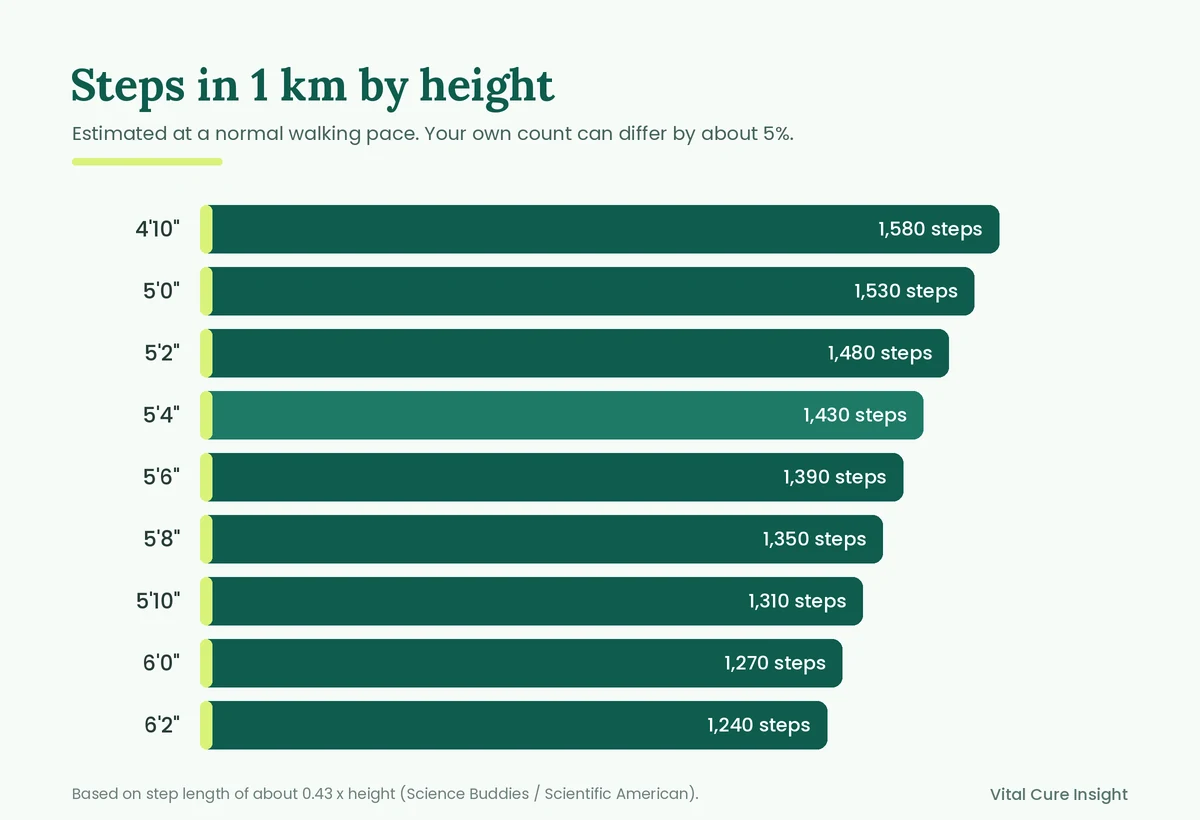
You might wonder why there’s no separate column for women. It isn’t needed. Height, and with it leg length, does nearly all the work, so a 5’2″ man and a 5’2″ woman need about the same number of steps for a kilometre.
Steps for 2 km, 3 km and 5 km
| Distance or steps | At 5’4″ | At 5’10” |
|---|---|---|
| 2 km | about 2,860 steps | about 2,620 steps |
| 3 km | about 4,290 steps | about 3,920 steps |
| 5 km | about 7,150 steps | about 6,540 steps |
| 5,000 steps | about 3.5 km | about 3.8 km |
| 8,000 steps | about 5.6 km | about 6.1 km |
How long does it take to walk 10,000 steps?
How long will 10,000 steps take? A 2011 paper in the International Journal of Behavioral Nutrition and Physical Activity treated 100 steps a minute as a fair starting point for moderate walking, and pointed out that 30 minutes at that rate gives you at least 3,000 steps. Do the sums and 10,000 steps works out to roughly 100 minutes, with each kilometre taking 13 to 16 minutes depending on your height. Don’t let that 100 put you off. You’re already clocking steps all day, in the kitchen, at the office, on the way to the bus stop, so a proper walk only has to fill the gap.
Measure your own steps in 1 km (two-minute test)
A chart can only guess. Your own number takes about two minutes to find.
- Find a known distance. A school or stadium running track is ideal, since one lap of a standard outdoor track is 400 metres. A measured 20-metre stretch of corridor or terrace also works.
- Walk at your normal pace and count your steps. Don’t stretch your legs to make it look better.
- Work out your steps per km. For a 400 m lap, multiply your step count by 2.5. For a 20 m stretch, multiply by 50.
- Update your step app. Most phone and watch step counters let you enter your height or step length, which makes their distance figure more accurate.
Repeat it once more and average the two. If there’s a walking track in your colony park, this also tells you how many rounds make a kilometre, which is handy on days you leave your phone at home.
What the evidence says: is 10,000 steps a day really needed?
Here’s something most step apps won’t tell you: the 10,000 figure never came out of a study. A 2019 paper in JAMA Internal Medicine says nobody is quite sure where it started, though it probably goes back to a Japanese pedometer from 1965 called Manpo-kei, which literally means “10,000 steps meter”. The same study tracked 16,741 women with an average age of 72. Those managing about 4,400 steps a day had lower death rates than women at about 2,700, and the benefit flattened out at around 7,500.
Bigger studies tell a similar story. A 2022 meta-analysis in The Lancet Public Health pooled data from 15 studies and 47,471 adults. The risk of dying kept dropping as steps went up, until about 6,000 to 8,000 a day in people aged 60 and over, and about 8,000 to 10,000 in younger adults. Then a 2025 review in the same journal looked at 57 studies. Compared with 2,000 steps, 7,000 a day was tied to a 47% lower risk of early death and a 38% lower risk of dementia. At 10,000 steps, the risk of death was almost the same as at 7,000.
For context, the World Health Organization recommends at least 150 minutes of moderate activity a week for adults, and the 2011 steps paper estimated that 7,000 to 8,000 steps a day roughly lines up with such guidelines.
So where does that leave you? These are all observational studies, so they show links, not proof. But they keep pointing the same way. If you’re stuck at around 3,000 steps a day, climbing to 6,000 or 7,000 will do far more for you than chasing a perfect 10,000. Walk more than that if you enjoy it; some outcomes may improve a little further. Stopping at 8,000 isn’t failing, though.
A simple plan to walk more each day
- Check your average steps for one ordinary week first. That number is your starting point, not your target.
- Add around 1,000 steps a day, roughly 10 minutes of walking, and hold it for a week or two before adding more.
- Take a short stroll after lunch or dinner. Many Indian families already do this, and it adds up quickly.
- Turn errands into steps: walk to the sabzi market or the chemist, use the stairs, and pace around while you’re on a call.
- Walk with someone. An evening round with family or a friend is far easier to keep up than a number on a screen.
Short on time? Our 10-minute workouts for busy professionals fit around a walking routine, and if you travel often, see how to stay fit while travelling. Students can build walking into a simple morning routine.
Common myths about steps and distance
“10,000 steps is always 8 km.” Only if you’re fairly tall. At 5’2″, it’s closer to 7 km, which is why two people on the same evening walk can see different distances on their phones.
“Anything under 10,000 steps is useless.” Not according to the studies above. The biggest drop in risk showed up when people moved from very few steps to a moderate number.
“My phone’s distance is exact.” Phones estimate distance from steps and the height you entered, and they miss steps when the phone is on a table or in a bag. Use it as a guide.
“Women need a separate formula.” As we saw in the chart, height is what matters. Pick the row closest to your height and you’re set.
Who should be careful
Walking is about as low-risk as exercise gets. Still, check with your doctor before pushing your step count up quickly if any of these apply to you:
- Heart or lung disease: ask your doctor how much and how fast to walk, especially after a heart attack or surgery.
- Diabetes: wear well-fitting shoes and check your feet regularly, particularly if you have numbness in your feet.
- Knee or hip arthritis: start slowly on flat ground and build up over weeks rather than days.
- Pregnancy: walking is usually encouraged, but follow your doctor’s advice on how much is right for you.
- Older adults with balance problems: choose even, well-lit paths and good footwear to lower the risk of falls.
Stop and get medical help if you have chest pain, unusual breathlessness, dizziness or fainting while walking.
Frequently asked questions
How many km is 10,000 steps?
For most adults, 10,000 steps is about 6.3 to 8.1 km. The exact figure depends on your step length, which depends mostly on height. At 5’4″ it works out to about 7 km, and at 5’10” about 7.6 km. Measuring your own step length gives the most accurate answer.
How many steps is a 1 km walk?
A 1 km walk usually takes about 1,240 to 1,580 steps. Taller people need fewer steps because each step covers more ground. Someone 5’4″ takes roughly 1,430 steps per km. Count your steps over one 400 m track lap and multiply by 2.5 to get your own number.
How many steps are in 2 km?
Roughly 2,500 to 3,200 steps, depending on height. At 5’4″ it’s about 2,860 steps, and at 5’10” about 2,620 steps. A 2 km walk at a moderate pace takes most people around 25 to 30 minutes.
Is 10,000 steps a day necessary?
No. The 10,000 target likely began with a 1965 Japanese pedometer, not a study. Research links health benefits with roughly 7,000 to 10,000 steps a day, with the biggest gains when inactive people start walking more. Any increase from a low baseline is worthwhile.
How long does it take to walk 10,000 steps?
At a moderate pace of about 100 steps a minute, 10,000 steps takes roughly 100 minutes. You don’t need to do it in one go. Steps from housework, errands, stairs and short walks after meals all count towards your daily total.
1 km mein kitne kadam hote hain?
In Hindi, people often ask how many kadam (steps) are in 1 km. The answer is about 1,240 to 1,580 steps for most adults, depending on height. A person who is 5’4″ takes around 1,430 steps to walk one kilometre at a normal pace.
The bottom line
Quick recap: 10000 steps in km comes to roughly 6.3 to 8.1 km, and a kilometre takes somewhere around 1,240 to 1,580 steps, mostly depending on how tall you are. The chart gets you close, one lap of a 400 m track gets you exact, and 10,000 is a goal, not an exam you pass or fail. Going from a few thousand steps to 7,000 or 8,000 is where most of the benefit seems to sit. For more practical guides, browse our Fitness section.
Sources
- Paluch AE, et al. Daily steps and all-cause mortality: a meta-analysis of 15 international cohorts. The Lancet Public Health. 2022.
- University of Sydney. Rethink the 10,000 a day step goal, study suggests (Ding M, et al., The Lancet Public Health). 2025.
- Lee I-M, et al. Association of Step Volume and Intensity With All-Cause Mortality in Older Women. JAMA Internal Medicine. 2019.
- Tudor-Locke C, et al. How many steps/day are enough? For adults. International Journal of Behavioral Nutrition and Physical Activity. 2011.
- World Health Organization. Physical activity (fact sheet). 2024.
- Science Buddies / Scientific American. Stepping Science: Estimating Someone’s Height from Their Walk. Accessed October 2026.
This article is for general information and is not a substitute for advice from your doctor.
Free weekly email
One evidence-checked health read, straight to your inbox.
New articles and myth-busts, with the sources linked. No spam — unsubscribe any time.
By subscribing you agree to receive emails from Vital Cure Insight. See the privacy policy.