Heart rate synchronization is when two people’s heart rates rise and fall in a linked pattern while they spend time together. Small studies have seen it in couples sitting quietly side by side, holding hands, and even sleeping in the same bed. What the research hasn’t shown is that deliberately syncing your heartbeat will strengthen a relationship. Below we walk through the main studies, what they can and can’t tell us, and a simple 10-minute routine for couples that rests on better evidence.
Quick answer
- Heart rate synchronization (also called physiological synchrony) has been measured in couples, friends and even people sharing a ritual.
- Studies are small, often 8 to 32 couples, so treat the findings as interesting, not settled.
- Hearts don’t beat “as one”. Patterns move together, often with one partner leading and the other following.
- Slow breathing (under 10 breaths a minute) has better evidence for calming you down than syncing does for bonding.
What is heart rate synchronization?
Your heart rate isn’t fixed. It speeds up when you stand, laugh or argue, and slows when you relax or breathe out. Heart rate synchronization means that when two people are together, those ups and downs start to line up in time. Researchers often call it physiological synchrony or co-regulation.
It doesn’t mean both hearts beat at exactly the same speed. In most studies the patterns are related, with a delay, and sometimes one person clearly leads. Scientists measure it with ECG sensors in a lab or, more recently, with wearables like a Fitbit at home.
Do couples’ heartbeats really sync? What the studies found
Here are the studies people usually quote, and what each one actually tested:
| Study | What they tested | What they found |
|---|---|---|
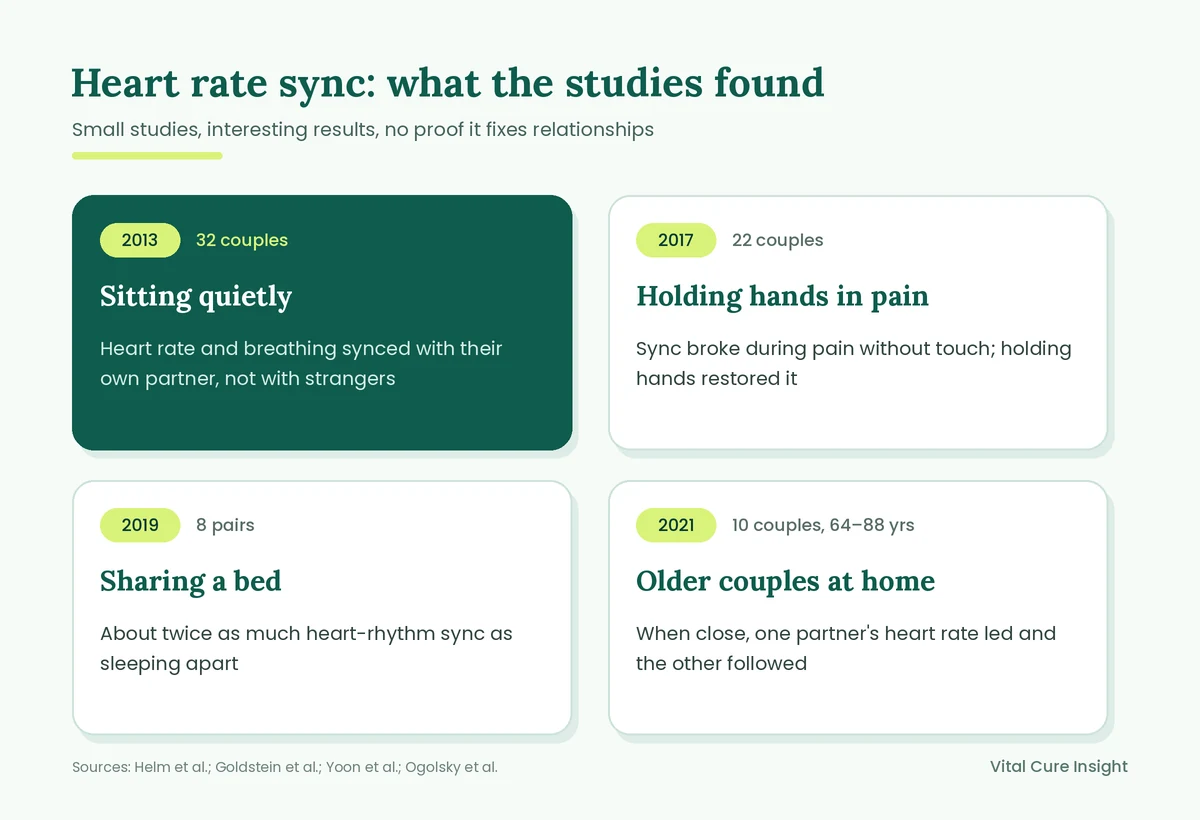
| Helm, Sbarra and Ferrer (2013) | 32 couples sitting quietly a few feet apart, not talking or touching | Partners’ heart rates and breathing synced; random pairs from different couples didn’t. Women adjusted more to their partners. |
| Goldstein and colleagues (2017) | 22 couples; the woman got mild heat pain while the man sat with or without holding her hand | Sync broke down during pain without touch. Holding hands brought it back, and her pain eased. |
| Yoon and colleagues (2019) | 8 pairs sleeping in the same bed vs separate beds | About twice as much heart-rhythm synchrony when sharing a bed, possibly from tiny vibrations through the mattress. |
| Ogolsky and colleagues (2021) | 10 older couples aged 64 to 88, wearing Fitbits at home for two weeks | When close together, one partner’s heart rate led and the other followed. Patterns changed from day to day. |
| Konvalinka and colleagues (2011) | 38 people at a fire-walking ritual in Spain | Fire-walkers’ heart rates synced with related spectators, but not with unrelated ones. |
Two things stand out. First, the samples are tiny. Second, synchrony isn’t only a romantic thing: the 2019 sleep study included friends and co-workers, and the ritual study found it between family and friends. It seems to reflect attention and closeness in general, not a special “soulmate” signal.
Does syncing your heart rate make a relationship stronger?
This is where many articles go too far. None of the studies above asked couples to sync on purpose and then measured whether their relationship improved. They observed synchrony; they didn’t test it as a treatment.
Synchrony also isn’t automatically good. The Illinois researchers point out that being close during a fight is very different from being close during a loving moment, and that heart rate changes can be positive or negative. A 2017 systematic review of this whole field called the research fragmented, which makes it hard to judge how consistent the results are.
Our reading: heart rate synchronization looks like a side effect of two people paying attention to each other. So the useful goal isn’t to chase a matching heart rate. It’s to create calm, undistracted time together, and the body may follow.
Breathing together: what it can and can’t do
Breathing has stronger evidence, though for you as an individual rather than for the couple. A 2018 systematic review in Frontiers in Human Neuroscience looked at slow breathing, defined as fewer than 10 breaths a minute, in healthy people. Out of 2,461 abstracts, 15 studies qualified. Slow breathing increased heart rate variability and was linked with more comfort and relaxation and fewer symptoms of anxiety, anger and depression.
If you’ve done anulom vilom or simply long exhales at the end of a yoga class, you know the feeling. When two people breathe slowly side by side, both relax, and that shared calm may be what partners notice. Any heart rate syncing is a bonus, not the point.
A simple 10-minute routine for couples
You don’t need to measure heart rate synchronization to benefit. This routine draws on the parts with the best support: slow breathing, touch and undistracted time. It suits a small flat or a busy joint-family home, since all you need is a quiet corner, a terrace or an evening walk.
- Put the phones away and switch off the TV. Our digital detox guide has more ideas for screen-free time.
- Sit side by side and hold hands. Touch is what restored synchrony in the 2017 pain study.
- Breathe slowly for five minutes. Try breathing in for 4 counts and out for 6. That’s about six breaths a minute, well under the 10-breath mark used in research. One partner sets the pace and the other follows.
- Talk for a few minutes. Share one good thing from the day. Leave problem-solving for another time.
- Repeat most evenings. After dinner or before sleep works well. On busy days, a slow walk together counts too.
If stress at work is spilling into home life, our guide on workplace stress and burnout may help, and good rest matters as well: see how sleep supports your health.
Common myths about heart rate synchronization
“Your hearts beat as one.” They don’t. Even in the bed-sharing study, synchrony was close to but not exactly one-to-one, and it came and went.
“If your hearts sync, you’re meant to be.” Friends, co-workers and family members also showed synchrony in these studies. It isn’t a compatibility test.
“Your smartwatch can measure your love.” Consumer wearables track your own heart rate. Working out synchrony needs both partners’ data and specialised analysis, and even then it doesn’t measure love.
“More synchrony is always better.” Couples can also sync during conflict or stress. Context matters more than the number.
What the evidence says
Heart rate synchronization is real and measurable, but the evidence comes from small studies of mostly young, heterosexual couples in labs, plus one study of 10 older couples at home. It appears when people are close and paying attention to each other, and touch seems to help it along. There’s no trial showing that syncing on purpose improves a relationship. Slow breathing, on the other hand, has decent evidence for calming the body and mind, so we’d frame breathing together as a relaxation habit you share, not a relationship cure.
Who should be careful
- Heart conditions: if you have an arrhythmia, a pacemaker or take heart medicines, slow breathing is usually gentle, but ask your doctor before starting any new routine, and stop if you feel dizzy or unwell.
- Anxiety or panic attacks: focusing on breathing can feel uncomfortable for some people at first. Go gently and keep the pace comfortable.
- Relationship conflict: breathing together won’t fix ongoing fights, distance or hurt. A couples counsellor can help you work through those.
- Abuse or control: if a partner hurts, threatens or controls you, no exercise is the answer. Reach out to someone you trust or a support service.
If stress, low mood or relationship worries are wearing you down, you can call Tele-MANAS, the Health Ministry’s free mental health helpline, on 14416, or speak to your doctor. For gentler day-to-day calming ideas, see our piece on olfactory meditation for stress.
Frequently asked questions
Can your heart rate sync with someone you love?
Yes, studies suggest it can. In a 2013 study of 32 couples sitting quietly, partners’ heart rates and breathing synced, while random pairs did not. But synchrony also appears between friends and family, so it reflects closeness and attention, not proof that someone is “the one”.
Do heartbeats sync when you cuddle?
Close contact seems to help. A 2019 study found about twice as much heart-rhythm synchrony when pairs slept in the same bed, and a 2017 study found that holding hands restored synchrony during pain. No study we found measured cuddling specifically, so the exact effect is unknown.
Do heartbeats sync when kissing?
We couldn’t find a study that measured this. Kissing raises heart rate for both people, so their rates may rise together, but that’s not the same as proven synchrony. Treat claims about kissing and heart sync as unverified for now.
Do people’s heartbeats sync when they pray together?
There’s no direct study on prayer that we found. The closest is a 2011 study of a fire-walking ritual in Spain, where participants’ heart rates synced with related spectators but not unrelated ones. Shared rituals may bring people’s bodies into step, but prayer itself hasn’t been tested.
Is heart rate synchronization good or bad?
It depends on the moment. Synchrony during a calm or loving interaction may reflect connection, but couples can also sync during stress or conflict. Researchers caution that heart rate changes can be positive or negative, so synchrony alone doesn’t tell you whether a relationship is healthy.
How can couples practise breathing together?
Sit side by side, hold hands and breathe in for 4 counts and out for 6 for about five minutes, with one partner setting the pace. Slow breathing under 10 breaths a minute is linked with relaxation. Stop if either of you feels dizzy, and keep it comfortable.
The bottom line
Heart rate synchronization is a fascinating sign that two bodies respond to each other, but the research is small and it isn’t a tool for fixing a relationship. What you can do is make room for calm time together: phones away, hands held, slow breaths and an honest chat. That habit is good for each of you, whatever your heart rates are doing. For more on stress, mood and relationships, browse our Mental Wellness section.
Sources
- UC Davis. Lovers’ hearts beat in sync, UC Davis study says (Helm, Sbarra and Ferrer). 2013.
- University of Colorado Boulder. A lover’s touch eases pain as heartbeats, breathing sync (Goldstein, Weissman-Fogel and Shamay-Tsoory, Scientific Reports). 2017.
- Yoon H, et al. Human Heart Rhythms Synchronize While Co-sleeping. Frontiers in Physiology. 2019.
- University of Illinois. When older couples are close together, their heart rates synchronize (Ogolsky et al., Journal of Social and Personal Relationships). 2021.
- Konvalinka I, et al. Synchronized arousal between performers and related spectators in a fire-walking ritual. PNAS. 2011.
- Palumbo RV, et al. Interpersonal Autonomic Physiology: A Systematic Review of the Literature. Personality and Social Psychology Review. 2017.
- Zaccaro A, et al. How Breath-Control Can Change Your Life: A Systematic Review on Psycho-Physiological Correlates of Slow Breathing. Frontiers in Human Neuroscience. 2018.
- Vikaspedia (Government of India). Tele-MANAS. Accessed October 2026.
This article is for general information and is not a substitute for advice from your doctor.
Free weekly email
One evidence-checked health read, straight to your inbox.
New articles and myth-busts, with the sources linked. No spam — unsubscribe any time.
By subscribing you agree to receive emails from Vital Cure Insight. See the privacy policy.