
Is ghee good for acne-prone skin? Probably not as a face cream. We could not find a single human study testing ghee on acne, and it is almost pure fat, which is the kind of heavy, greasy product dermatologists tell acne-prone people to avoid. Eating ghee in normal amounts is a different question, and there the evidence is thin either way. Below we separate applying ghee from eating it, look at what Ayurvedic shata dhauta ghrita can and can’t claim, and give you a safer way to use ghee on skin if you still want to.
Quick answer
- No study has tested ghee on acne in people, so claims that it “cures pimples” have nothing behind them.
- Ghee is at least 99.5% milk fat. Dermatologists advise acne-prone skin to use non-comedogenic products that won’t clog pores, and ghee has never been tested as one.
- Eating ghee hasn’t been studied for acne. Milk has been, and a 2018 meta-analysis linked dairy with slightly higher odds of acne.
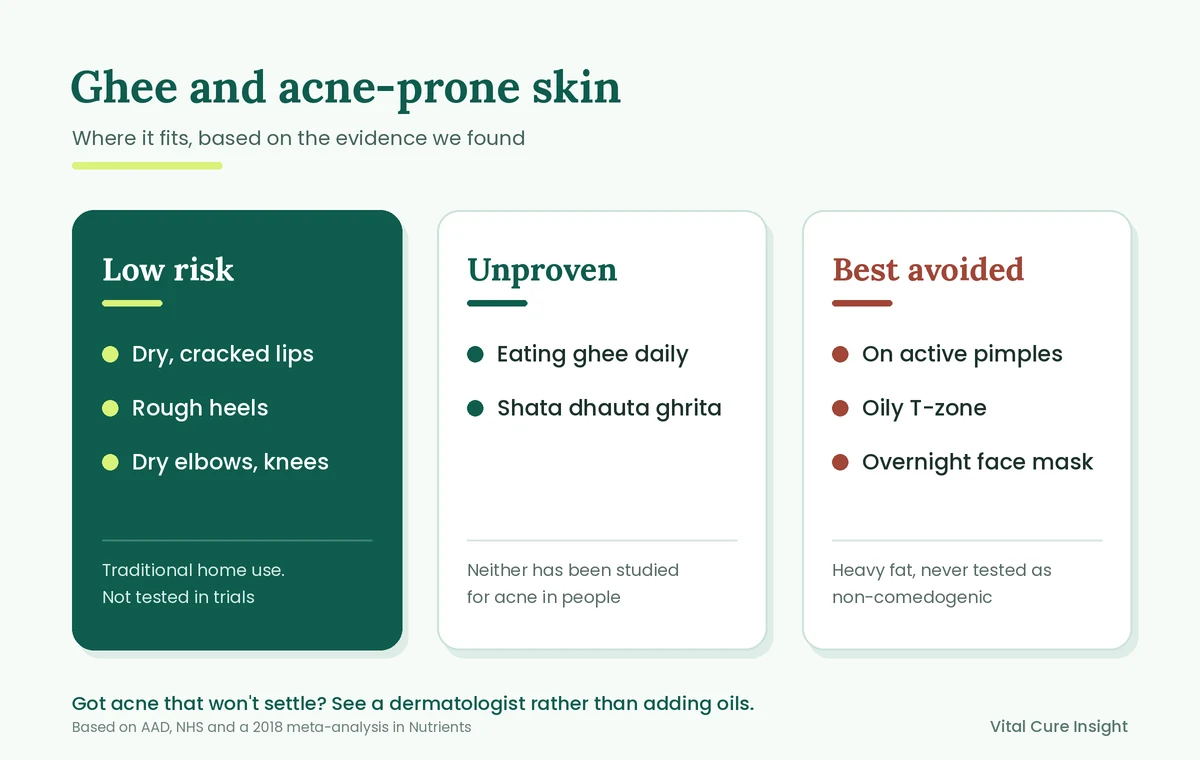
- Ghee on dry lips, heels or elbows is fine for most people. Keep it off active pimples and the oily T-zone.
Why so many Indian homes put ghee on skin
Most of us grew up with it. A dab of ghee on cracked lips in winter, on a baby’s dry patches, on rough heels before bed. Ayurveda also uses a special preparation called shata dhauta ghrita, which is ghee washed a hundred times with water until it turns light and creamy, as a skin balm. So when someone asks whether ghee is good for acne-prone skin, they’re really asking whether this trusted kitchen remedy also works for pimples.
That’s where the trouble starts. Dry skin and acne-prone skin need very different things. Dry skin often benefits from a rich, oily layer. Acne-prone skin usually doesn’t.
Is ghee good for acne-prone skin? What the evidence says
Applying ghee on your face
Under India’s grading standard, ghee is at least 99.5% milk fat, so putting it on your face means coating the skin in pure fat. The NHS advises people with acne to use skincare that is non-comedogenic, meaning it won’t clog pores, and lists greasy skin and hair products among the things that can make acne worse. Ghee has never been tested or labelled as non-comedogenic.
There’s a very Indian twist here too. The American Academy of Dermatology (AAD) notes that hair oil can contribute to breakouts on the forehead, and suggests that people with oily hair shampoo more often and keep hair off the face. If you oil your hair overnight and have pimples along the hairline, that may be worth looking at before you blame your diet.
To be fair, nobody has proven that ghee causes acne either. The honest position is that it is untested, and the general dermatology advice for acne-prone skin points away from heavy oils.
What about shata dhauta ghrita?
Washed ghee is lighter and easier to spread than kitchen ghee, and it’s sold as a moisturiser. The research we found, though, was limited to lab formulations and animal work, such as a 2015 study on burn wounds in rats. That tells us nothing about pimples on human faces. It may be a reasonable moisturiser for dry skin, but it isn’t an acne treatment.
Eating ghee and pimples
Ghee itself hasn’t been studied for acne, but other dairy has. A 2018 meta-analysis in Nutrients pooled 14 studies of 78,529 people aged 7 to 30. Any dairy was linked with 25% higher odds of acne, any milk with 28% and low-fat or skim milk with 32%. The authors warned that the studies varied a lot and had risks of bias, so this is a link, not proof. The AAD similarly says all types of cow’s milk have been linked to acne, while calling the reason “still a bit of a mystery”.
Ghee is mostly fat, with very little of milk’s protein and sugar, so we can’t assume those milk findings apply to it, in either direction. Our view: if you have acne, there’s no good reason to cut a teaspoon of ghee from your dal for your skin’s sake. If you drink several glasses of milk a day and keep breaking out, that’s a more reasonable thing to discuss with your dermatologist. Our guide on how much milk to drink daily covers sensible amounts.
| How you use ghee | What we know | Our verdict |
|---|---|---|
| On active pimples or the oily T-zone | Never tested; heavy fat | Avoid |
| As an overnight face mask | Never tested; stays on skin for hours | Avoid if acne-prone |
| On dry lips, heels, elbows | Traditional use, no trials | Fine for most people |
| Shata dhauta ghrita on dry skin | Lab and animal studies only | Patch test first; not for acne |
| Eating ghee in normal meals | Not studied for acne | No need to cut it for skin |
| Drinking a lot of milk | Linked with acne in observational studies | Worth noting if you break out |
If you still want to use ghee on your skin: a safer way
Plenty of people with combination skin use ghee on dry areas without trouble. If you want to try, do it in a way that lets you spot a problem early.
- Start with pure ghee. Adulterated ghee may contain vanaspati or other fats. Here’s how to check purity of ghee at home.
- Patch test first. The AAD’s method for testing a new skin product is to apply it twice a day for 7 to 10 days on a small spot on the underside of your arm or the bend of your elbow. Redness, itching or swelling means stop.
- Use it only on dry areas. Lips, heels, elbows and knees are the sensible places. Skip the forehead, nose, chin and any area with active pimples.
- Use a tiny amount. A rice-grain amount is enough for lips. More doesn’t mean better.
- Watch for two weeks. A patch test on your arm won’t show whether ghee clogs pores on your face. If you try a small area of your cheek, look out for new blackheads or small bumps there over the next couple of weeks, and stop if they appear.
- Keep hair oil away from your face. Tie oiled hair back and wash your pillowcase often.
For other home remedies for dry skin, see our guide to homemade face masks for dry skin, and for everyday habits that matter more than any single ingredient, read natural ways to achieve clear and healthy skin.
Common myths about ghee and skin
“Ghee cures pimples and removes acne scars.” We found no study in people showing either. Scars in particular need treatments a dermatologist can offer.
“Natural means it won’t clog pores.” Whether something clogs pores depends on what it is and how it behaves on skin, not on where it came from.
“The glow after ghee means healthy skin.” That shine is a layer of fat on the surface. It can look nice, but it isn’t a sign that anything has changed underneath.
“If your pimples are from ‘heat’, ghee cools them.” The idea of heat in the body comes from traditional systems and hasn’t been tested as a cause of acne. Hormones, oil production, clogged pores and bacteria are what dermatologists treat.
What the evidence says
So, is ghee good for acne-prone skin? Put simply, there is no clinical evidence that applying ghee helps acne, and general dermatology advice for acne-prone skin favours light, non-comedogenic products over heavy fats. Shata dhauta ghrita has only lab and animal data. For eating, ghee hasn’t been studied, while milk shows a modest link with acne in observational studies of mixed quality. We’d treat ghee as a good moisturiser for dry patches, not as an acne remedy, and we’d rather you spend your effort on treatments that are proven.
Who should be careful
- Moderate or severe acne: deep, painful or scarring spots need medical treatment, not kitchen remedies.
- People already on acne treatment: if you use creams like benzoyl peroxide or retinoids, or tablets prescribed by a doctor, ask your dermatologist before adding any oil to your routine.
- Pregnancy: hormonal changes can trigger acne, and some acne medicines aren’t safe in pregnancy. Talk to your doctor before starting any treatment.
- Teenagers: acne is common during puberty. If it’s affecting confidence or mood, a doctor’s visit is worth it.
- Sensitive or eczema-prone skin: always patch test, and stop at the first sign of redness or itching.
The NHS suggests seeing a doctor if your acne isn’t improving with self-care, if spots are deep, painful or scarring, if you see signs of infection such as hot, swollen, red skin, or if it is affecting your mental health.
Frequently asked questions
Can I apply ghee daily on my face?
If your skin is dry and never breaks out, a thin layer may feel fine. If you’re acne-prone, daily ghee on the face isn’t a good idea: it’s pure fat, it hasn’t been tested as non-comedogenic, and dermatologists advise acne-prone skin to use products that won’t clog pores.
Can I leave ghee on my face overnight?
For acne-prone skin, we’d avoid it. An overnight layer stays on the skin for hours and can transfer to your pillow and hair. If you want to use ghee overnight, keep it to dry lips, heels or elbows, and patch test it on your arm first.
What are the disadvantages of ghee for skin?
It’s heavy and greasy, it hasn’t been tested for clogging pores, it can stain pillows and clothes, and adulterated ghee may contain other fats. Some people may also react to it. None of these matter much on dry heels, but they do on an acne-prone face.
Which is better for skin, ghee or coconut oil?
Neither has good evidence for acne. Both are rich fats that suit dry areas better than an oily or acne-prone face. If you break out easily, a fragrance-free moisturiser labelled non-comedogenic is the safer everyday choice for your face.
Does eating ghee cause pimples?
There’s no study showing it. A 2018 meta-analysis linked dairy, especially milk, with slightly higher odds of acne, but ghee wasn’t studied separately and is mostly fat. A teaspoon in your dal is unlikely to be the reason for your breakouts.
Can ghee remove acne scars?
We found no evidence that it can. Claims online come from tradition and brand blogs, not clinical studies. Acne scars respond to treatments such as prescription creams and in-clinic procedures, so see a dermatologist if scars bother you.
The bottom line
Ghee is a lovely balm for cracked lips and dry heels, but it isn’t an acne treatment, and there’s no evidence it is good for acne-prone skin. Keep it off pimples and oily areas, patch test before using it anywhere new, and see a dermatologist if your acne doesn’t settle. For more evidence-checked skin guides, browse our Skin & Beauty section.
Sources
- Juhl CR, et al. Dairy Intake and Acne Vulgaris: A Systematic Review and Meta-Analysis of 78,529 Children, Adolescents, and Young Adults. Nutrients. 2018.
- American Academy of Dermatology. Acne: Tips for managing. Accessed October 2026.
- American Academy of Dermatology. Can the right diet get rid of acne?. Accessed October 2026.
- American Academy of Dermatology. How to test skin care products at home. 2021.
- NHS. Acne. Accessed October 2026.
- Babu B, Ravi M, Kumar ABN, et al. Burn wound healing potential of plain gritha, shatadhauta ghrita and sahasradhauta ghrita on Wistar albino rats. Indian Journal of Traditional Knowledge. 2015.
- Warehousing Development and Regulatory Authority (WDRA). Ghee: quality specifications. Accessed October 2026.
This article is for general information and is not a substitute for advice from your doctor.
Free weekly email
One evidence-checked health read, straight to your inbox.
New articles and myth-busts, with the sources linked. No spam — unsubscribe any time.
By subscribing you agree to receive emails from Vital Cure Insight. See the privacy policy.

