
Want to check purity of ghee at home? Start with the label and your nose, then do FSSAI’s iodine test: add a few drops to a little ghee, and if it turns blue, starch or mashed potato has been mixed in. Melting and fridge checks give you a few more clues. What no kitchen test can do is reliably catch vanaspati, palm oil or animal fat blended in with care. Below, we rate seven popular home tests, explain what a lab looks for, and give you a simple routine for every new jar.
Quick answer
- The iodine test is the one home check with an official FSSAI method behind it. Blue means starch, potato or flour. No blue only rules out starch.
- Smell, melt and fridge checks are useful clues, not proof.
- Skip the water glass and palm tests. Every fat floats, and most blends melt on your hand just like ghee.
- If you suspect vanaspati or animal fat, stop using the jar and get it tested in a lab.
Why ghee gets adulterated, and why it matters for your health
Ghee is one of the costliest fats in an Indian kitchen, so stretching it with something cheaper has always paid. A 2016 paper in the Journal of Food Science and Technology notes that a 1960–1972 survey found 16% of ghee samples adulterated, and cites a later one where up to 43% of branded and 87.5% of unbranded samples did not match the fat profile of pure ghee. These are older figures from limited samples, so treat them as a warning sign, not a national rate.
The problem hasn’t gone away. In August 2026, Jammu and Kashmir’s Food and Drugs Administration barred the sale of 10 ghee batches after lab tests found foreign vegetable fat, beta-sitosterol (a plant sterol) and a positive Baudouin test.
Why should this worry you beyond the money? The usual cheap stand-in is vanaspati, a partially hydrogenated vegetable oil. The World Health Organization lists vanaspati among the sources of industrial trans fat and links high trans fat intake with a 21% higher risk of coronary heart disease. Starch and mashed potato are less of a health threat, but you are still paying ghee prices for aloo.
How to check purity of ghee at home: 7 tests, rated
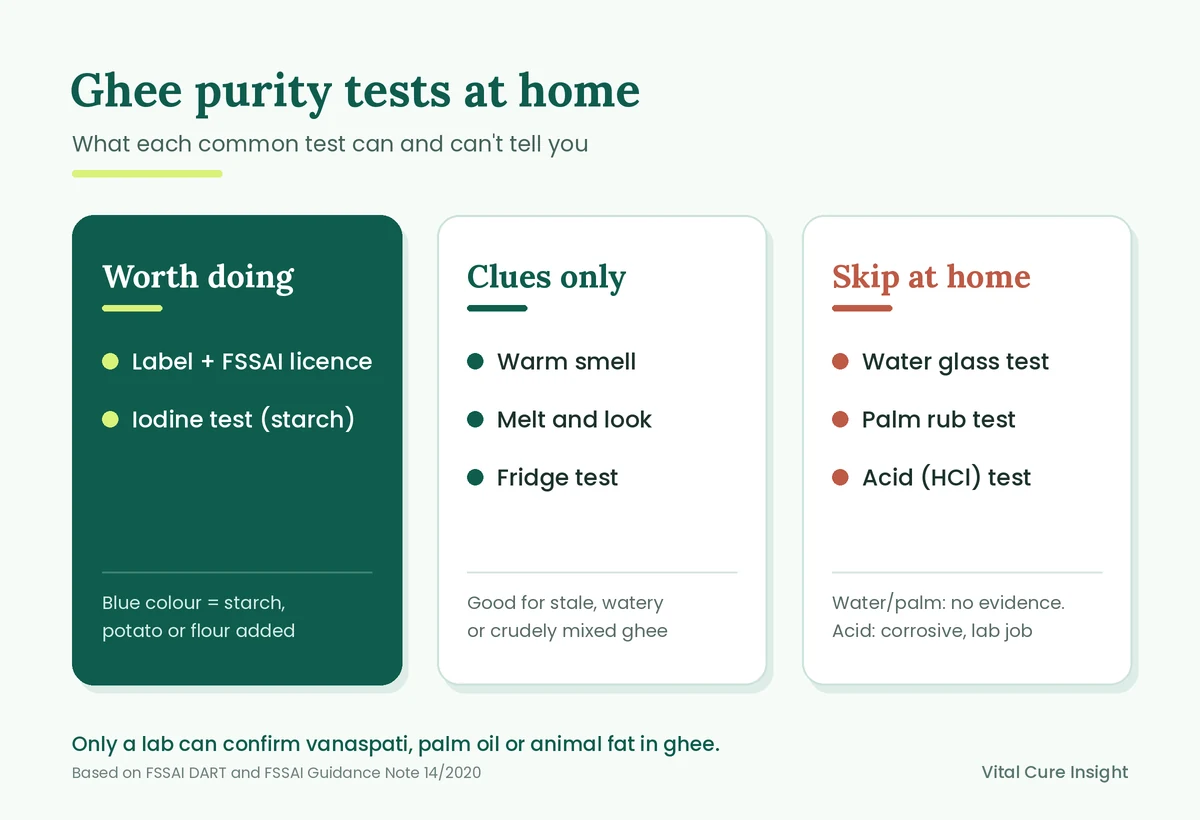
We judged each common test on two things: what it can actually catch, and whether an official method or basic science stands behind it. Here is the short version.
| Test | What it can catch | Our verdict |
|---|---|---|
| Label and licence check | “Vegetable fat” listed, no FSSAI licence or batch number | Do it every time |
| Iodine test | Starch, mashed potato, sweet potato | Reliable for starch only (FSSAI method) |
| Warm smell | Rancid, stale or artificially flavoured ghee | Useful clue |
| Melt and look | Sediment, cloudiness, leftover water | Useful clue |
| Fridge test | A large amount of liquid oil | Rough screen only |
| Palm rub | Very little | Skip |
| Water glass | Nothing: all fats float | Skip |
1. Read the label before you open the jar
The cheapest test happens in the shop. Pure ghee should list ghee or milk fat as its only ingredient. Words like “vegetable fat” or “hydrogenated” on a tin sold as ghee answer the question before you reach home. Look for a 14-digit FSSAI licence number and a batch number, and if something feels off, search the licence on FSSAI’s FoSCoS portal. Keep your expectations realistic: a valid number means the maker is on FSSAI’s books, nothing more about this particular batch.
Price is a clue too. Ghee takes a lot of milk to make, so a “desi ghee” that costs a few hundred rupees less per litre than every sealed brand deserves suspicion. And loose ghee from the local dairy isn’t automatically purer: FSSAI’s 2020 guidance note on traditional milk products advises avoiding loose products, and its 2019 Delhi-NCR survey found more problems in loose samples than packed ones.
2. The iodine test, step by step
If you only do one thing to check purity of ghee at home, make it this. It’s the one ghee test FSSAI publishes in its DART guide (Detect Adulteration with Rapid Test). You need iodine tincture, which most chemists stock.
- Put about half a teaspoon of ghee in a clear glass bowl. If it is solid, melt it gently and let it cool.
- Add 2 to 3 drops of iodine tincture.
- Look at the colour. Blue means mashed potato, sweet potato or another starch has been added.
- If you only see the brownish colour of the iodine itself, there’s no starch in it.
FSSAI’s 2020 guidance note gives a slight variation: boil a little sample with water, cool it, then add iodine. Either way, no blue rules out starch and nothing else. It tells you nothing about vanaspati, palm oil or animal fat. Throw the tested ghee away and keep the iodine out of children’s reach.
3 and 4. Smell it warm, then watch it melt
FSSAI describes good ghee as having a pleasant, nutty, slightly cooked aroma, and says that once melted it should be clear, transparent and free of sediment. That gives you a benchmark. Warm a teaspoon in a steel katori over a low flame and pay attention to three things.
The smell should remind you of fresh ghee on a hot roti, not old frying oil, soap, wax or a sweet, perfumed note. The melted ghee should look clear and even, with no gritty layer settling at the bottom. And listen to it. Heavy crackling means water is still inside. The government grading specification for ghee allows no more than 0.5% moisture, so pure ghee melts fairly quietly.
Colour helps less than most people think. According to FSSAI, cow ghee is naturally bright yellow while buffalo ghee is white with a greenish tinge, so a pale jar isn’t automatically fake and a deep yellow one isn’t proof of desi cow ghee. FSSAI also lists coal tar dyes as a possible ghee adulterant, which is one more reason not to judge by looks.
5. The fridge test: a rough screen
FSSAI’s DART guide uses a fridge test for coconut oil. Chill it for 30 minutes and, if other oils have been added, they stay behind as a separate liquid layer while the coconut oil sets. Many people borrow the same idea for ghee: melt a few spoons, pour them into a small glass, and leave it in the fridge (not the freezer).
If a clear, oily layer refuses to set, a liquid oil has probably been mixed in, and in a fair amount. But this is an adaptation, not an FSSAI ghee test. It misses small amounts of oil and can’t catch vanaspati or palm oil at all, because both set just like ghee. Palm oil turns up in more foods than you’d expect, as we found when we checked whether palm oil is used in ice cream.
6 and 7. Why the palm and water tests don’t tell you much
The water glass test is the most shared and the least useful. Drop ghee into water and it floats. So does mustard oil, so does vanaspati, and so does every other fat, because fats are lighter than water. Floating proves you have a fat, which you already knew.
The palm test assumes pure ghee melts fast on your skin and fake ghee doesn’t. But melting depends on the weather, your hand and whether it’s cow or buffalo ghee, and blends are made to behave like ghee. We found no study that supports palm melting as a purity check.
What about the hydrochloric acid test for vanaspati?
Plenty of videos show an acid test for vanaspati. FSSAI’s 2020 guidance note does describe one: a teaspoon of melted sample, 10 drops of hydrochloric acid, a gentle shake and a five-minute wait, with a red colour suggesting vanaspati. The same document says hydrochloric acid also turns crimson with coal tar dyes, so a red result doesn’t tell you which problem you have.
Our advice is to leave this one alone. Hydrochloric acid can burn skin and eyes, it isn’t a kitchen chemical, and any result still needs a lab to confirm it.
What a lab checks that your kitchen can’t
Labs don’t rely on smell or colour. They test ghee against fixed limits. Here are some of the key ones from the WDRA ghee specification, which follows the national food standards:
| Parameter | Limit for ghee | What it tells the lab |
|---|---|---|
| Milk fat | At least 99.5% | The product is almost entirely milk fat |
| Moisture | Not more than 0.5% | Whether water was left in |
| BR reading at 40°C | 40.0 to 43.0 | An optical fingerprint that other fats shift |
| RM value | At least 28 (lower in cotton-tract regions) | Milk fat is rich in short-chain fatty acids most other fats lack |
| Baudouin test | Negative | Sesame oil and vanaspati |
| Animal fat and phytosterol tests | Negative | Lard, tallow and plant-based fats |
Research labs go further. In the 2016 study above, infrared spectroscopy picked up goat body fat in ghee at levels as low as 1%. If scientists need instruments to find a few per cent of foreign fat, a glass of water at home was never going to.
Common ghee myths, corrected
“Grainy ghee is always pure.” FSSAI does call large, even grains with little liquid fat a sign of good texture, so grain says something about quality. We found no evidence, though, that grain on its own can separate pure ghee from a blend.
“Bilona or A2 on the label means it’s pure.” These words describe a churning method or a type of cow. They say nothing about whether another fat was added, and you can’t verify them in your kitchen. The ingredient list and licence matter more.
“If it burns well in a diya, it’s real.” Almost any fat will burn in a diya. None of FSSAI’s methods use burning as a purity test.
A simple 5-minute routine for every new jar
- In the shop: buy sealed. Check the ingredients (only ghee or milk fat), FSSAI licence, batch number and best-before date.
- On opening: smell it. Fresh and nutty is good; sour, soapy or waxy is not.
- Warm a teaspoon: it should melt clear, crackle little and leave no grit.
- Iodine test on half a teaspoon. Any blue, and the jar goes back.
- Optional fridge check for an oily layer that won’t set.
- If anything fails, stop using it, keep the jar and bill, and report it to your state food safety department or FSSAI’s consumer helpline, 1800112100.
Use ghee on your skin too? The same checks apply, and our look at whether ghee is good for acne-prone skin covers the evidence there.
What the evidence says
Put plainly, the tools you have to check purity of ghee at home are weaker than viral videos suggest. Only the iodine test has an official FSSAI method and gives a clear yes or no, and only for starch. Smell and melt checks match FSSAI’s description of good ghee but depend on your judgement, the fridge test is a borrowed coconut oil method, and the water and palm tests have nothing behind them. The adulterants that matter most for your heart, vanaspati and other foreign fats, need a lab. So buy carefully, test what you can, and send anything suspicious for testing.
Who should be careful
Even pure ghee is a saturated fat. ICMR-NIN’s Dietary Guidelines for Indians (2024) advise limiting butter and ghee, avoiding vanaspati, and keeping cooking fats to about 25 to 30 g a day for most adults, roughly five to six teaspoons of oil and ghee combined. Since ghee is concentrated milk fat, our guide on how much milk to drink daily helps you see your total dairy picture.
- Heart disease, high cholesterol or diabetes: purity matters more for you, because vanaspati adds trans fat. Stick to the fat limit your doctor or dietitian sets, and don’t treat “pure” as permission to eat more.
- Pregnancy: ICMR-NIN specifically advises avoiding foods made with hydrogenated fat during pregnancy. Choose sealed, licensed ghee and skip loose or unlabelled jars.
- Children: keep iodine tincture and any acid well out of reach, as both are harmful if swallowed. For young children, use small amounts of ghee from a trusted sealed pack.
- If you feel unwell after eating ghee you suspect, with vomiting, diarrhoea or stomach pain, see a doctor and keep the jar so it can be tested.
Frequently asked questions
Does pure ghee float or sink in water?
Pure ghee floats, but so do vanaspati, refined oil and every other fat, because fats are lighter than water. That is why the water glass test cannot tell pure ghee from a blend. Cloudiness in the water may hint at leftover moisture or milk solids, but it is not proof of adulteration.
How do I check if Amul or other branded ghee is original?
Buy from a reliable shop, make sure the seal is intact, and check the FSSAI licence number, batch number and dates printed on the pack. Look the licence up on FSSAI’s FoSCoS portal if anything seems odd. Then run the usual home checks: smell, a clear melt and the iodine test for starch.
Which brand of ghee is not adulterated?
We can’t vouch for any brand, and no home test can certify one. Official actions usually name specific batches, as in the 2026 Jammu and Kashmir notice, so check batch numbers against any alert from your state food safety department. Prefer sealed, licensed packs and report any jar that smells or melts wrong.
How does original desi ghee look and smell?
FSSAI describes good ghee as having a pleasant, nutty, slightly cooked aroma. Melted, it should be clear and free from sediment. Cow ghee is bright yellow and buffalo ghee is white with a greenish tinge. Once set, large and even grains with little liquid fat point to good texture.
How can I check vanaspati in ghee at home?
Reliably, you can’t. The acid test shared online uses hydrochloric acid, which is corrosive and also reacts with some dyes, so a red colour isn’t conclusive. Smell and fridge checks won’t catch vanaspati either, because it sets like ghee. If you suspect it, stop using the jar and get it lab-tested.
Is homemade ghee always pure?
Ghee you make from your own malai or butter has no added fats, which is a real advantage. It can still spoil if water is left in or you use a wet spoon, both of which make it turn rancid sooner. Cook it until the bubbling settles, cool it, and store it in a clean, dry jar.
The bottom line
Taking five minutes to check purity of ghee at home is worth it, as long as you know what each test can and can’t do. Read the label, trust your nose, do the iodine test, and treat the fridge check as a rough hint. Ignore the water glass and the palm rub. If a jar still worries you, the answer lies with a food testing lab, not a viral video. For more evidence-checked guides on everyday Indian foods, browse our Diet & Nutrition section.
Sources
- Food Safety and Standards Authority of India (FSSAI). DART: Detect Adulteration with Rapid Test. Eat Right India. Accessed October 2026.
- FSSAI. Guidance Note No. 14/2020: Guidance Note on Safety and Quality of Traditional Milk Products. 2020.
- Warehousing Development and Regulatory Authority (WDRA). Ghee: quality specifications (Commodity Code 249). Accessed October 2026.
- Upadhyay N, Jaiswal P, Jha SN. Detection of goat body fat adulteration in pure ghee using ATR-FTIR spectroscopy coupled with chemometric strategy. Journal of Food Science and Technology. 2016.
- World Health Organization. Trans fat (fact sheet). 2024.
- ICMR-National Institute of Nutrition. Dietary Guidelines for Indians. 2024.
- Kashmir Life. FDA Jammu Kashmir bans sale of 10 ghee batches after lab tests find violations. 2026.
This article is for general information and is not a substitute for advice from your doctor.
Free weekly email
One evidence-checked health read, straight to your inbox.
New articles and myth-busts, with the sources linked. No spam — unsubscribe any time.
By subscribing you agree to receive emails from Vital Cure Insight. See the privacy policy.