
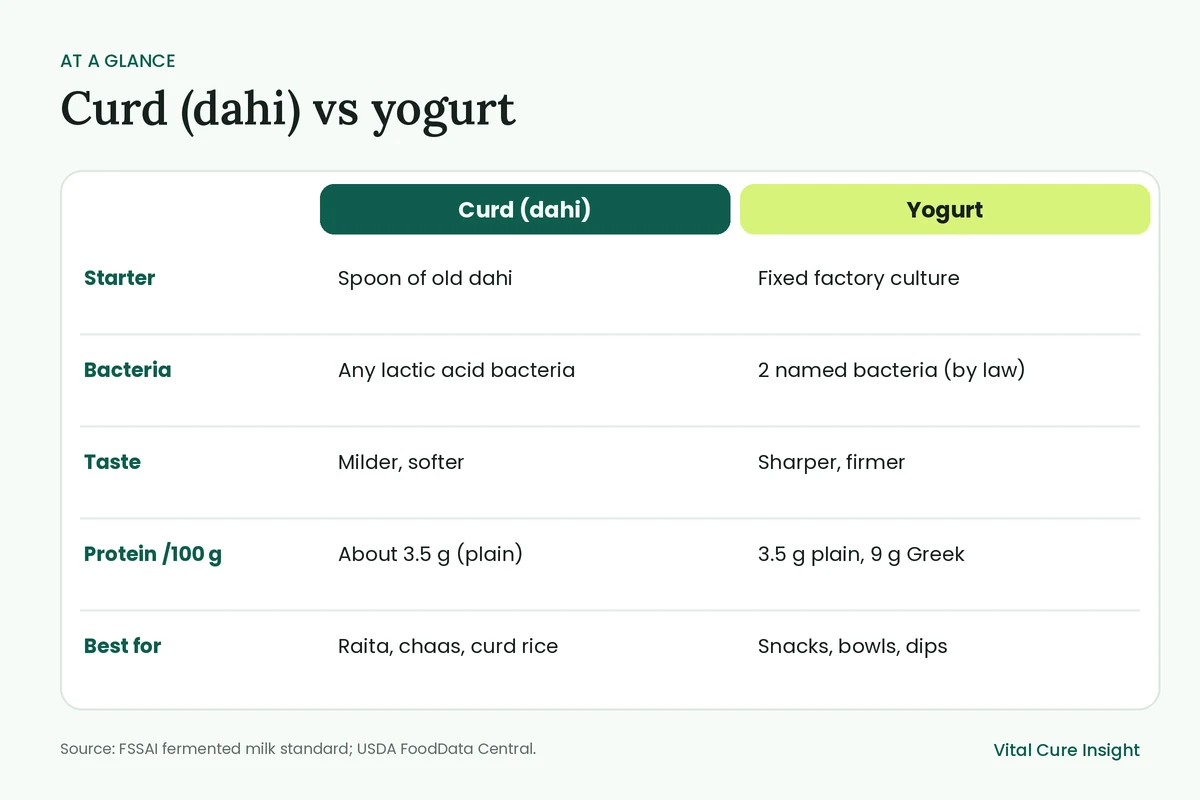
The main difference between curd and yogurt is the bacteria used to set the milk. Under FSSAI rules, yogurt has to be made with two particular bacteria, while dahi (curd) can be set with any lactic acid bacteria, which is exactly what happens when you add a spoon of yesterday’s dahi to warm milk. Nutritionally, the two are close cousins. Below we explain the rules in plain words, compare nutrition, look at Greek yogurt and hung curd, and help you pick the right tub at the shop.
Quick answer
- The real difference is the starter bacteria. By FSSAI and international rules, yogurt must use two specific bacteria; dahi (curd) can use any lactic acid bacteria.
- Plain curd and plain yogurt made from similar milk are nutritionally very close.
- Greek yogurt and hung curd are strained, so they have more than double the protein of regular yogurt.
- For daily use, plain beats flavoured. Added sugar matters more than the name on the tub.
Why do Indians call it curd, and is dahi the same thing?
In most Indian homes, “curd” and “dahi” mean the same bowl: milk set overnight with a little starter from the last batch. “Yogurt” is the word we mostly see on shop shelves, often next to words like “Greek” or “probiotic”.
So dahi and curd are one food with two names. Yogurt is a close relative, and the line between them is drawn by the starter culture, not by taste or price. FSSAI’s standard uses the name “Dahi” for this product; a 2023 amendment removed the bracketed word “(Curd)” that used to sit next to it in the regulation.
The real difference between curd and yogurt: the bacteria
This is the part most articles skip, and it is the only difference that is actually written into law. India’s food regulator, FSSAI, sets standards for fermented milk products. In its table of starter cultures:
- Dahi is made with “lactic acid bacteria”. That is a broad family, so many different mixes qualify.
- Yoghurt must be made with a partnership of two named bacteria: Streptococcus thermophilus and Lactobacillus delbrueckii subsp. bulgaricus.
The international food code agrees. The Codex Standard for Fermented Milks (adopted 2003, revised 2010) defines yoghurt by the same two bacteria. So does the US yogurt rule, 21 CFR 131.200.
What this means for you: your homemade dahi may well contain those same two bacteria, plus others. Nobody tests the katori in your fridge, so its exact mix depends on your starter, the season and how warm your kitchen is. Packaged yogurt, on the other hand, is made to a fixed recipe.
Other small differences in the rules
FSSAI also asks packaged products to meet a few numbers until their best-before date. Both packaged dahi and yoghurt must keep at least 10 million live starter bacteria per gram (written as 107 cfu/g) and at least 2.9% milk protein. Yoghurt must be a bit more sour, with minimum acidity of 0.6% against 0.45% for dahi. That matches what many of us notice: shop yogurt often tastes sharper and sets firmer than a mild home dahi.
One more thing worth knowing. The US rule allows yogurt to be heat-treated after it sets, to make it last longer. When that happens, the label has to say “does not contain live and active cultures”. So “yogurt” on a tub does not automatically mean live bacteria. Read the label.
Curd vs yogurt vs Greek yogurt at a glance
| Home-set curd (dahi) | Packaged yogurt | Greek yogurt / hung curd | |
|---|---|---|---|
| How it’s made | Warm milk plus a spoon of old dahi as starter | Milk plus a fixed factory culture | Curd or yogurt strained to remove whey |
| Bacteria | Mixed lactic acid bacteria, varies batch to batch | Two named bacteria, by law | Same as what it was made from |
| Taste and texture | Usually milder, softer | Often sharper, firmer | Very thick and creamy |
| Live cultures | Yes, if eaten fresh | Check the label | Check the label |
| Best Indian uses | Rice, raita, chaas, kadhi | Snacks, smoothies, bowls | Dips, shrikhand, high-protein snacks |
Nutrition: is yogurt higher in protein than curd?
Plain curd and plain yogurt made from the same milk end up very similar, because both are simply fermented milk. FSSAI’s standard even says the fat and solids of plain dahi should match the class of milk it was made from. Toned milk gives you a lighter dahi; full-cream milk gives a richer one.
Greek yogurt is where the numbers really change. Straining removes much of the watery whey, so what’s left is more concentrated. Here is how the two compare per 100 g, using USDA FoodData Central figures for whole-milk versions:
| Per 100 g | Plain yogurt (whole milk) | Greek yogurt (whole milk) |
|---|---|---|
| Energy | 61 kcal | 97 kcal |
| Protein | 3.5 g | 9 g |
| Fat | 3.3 g | 5 g |
| Carbohydrate | 4.7 g | 4.0 g |
| Calcium | 121 mg | 100 mg |
| Potassium | 155 mg | 141 mg |
So Greek yogurt has well over double the protein of plain yogurt, but a little less calcium and more calories. Hung curd, made by tying dahi in a muslin cloth for a few hours, works on the same principle. It’s the desi, cheaper route to a thick, higher-protein curd.
Curd or yogurt: which is healthier?
Our honest verdict: neither wins on its own. The choice that matters far more is plain versus flavoured. A plain katori of dahi and a plain cup of yogurt are nutritionally close. A mango or strawberry yogurt with added sugar is closer to a dessert.
Both help people who struggle with milk. A 2014 paper in the American Journal of Clinical Nutrition explains that the live bacteria in yogurt carry their own lactase, the enzyme that breaks down milk sugar, and this helps lactose-intolerant people digest it. The ICMR-NIN Dietary Guidelines for Indians (2024) give similar practical advice: people who have trouble with milk can take it as curd. The same guidelines include “plain fermented yogurt or curd” as part of a healthy meal.
If you want more protein, say for a vegetarian breakfast, Greek yogurt or hung curd is the better pick. If you want it for raita, chaas or curd rice, home dahi does the job perfectly well and costs less. It fits neatly as the dairy part of a balanced round meal with roti, dal and sabzi.
What the evidence says about “probiotic” claims
Many yogurt tubs now carry the word “probiotic”, often at a higher price. The US National Center for Complementary and Integrative Health (NCCIH) puts it plainly: a lot of research has been done on probiotics, but much remains to be learned about whether they help and are safe. Some specific strains show benefit for specific problems; a general “good for gut” promise is much weaker.
Our take: enjoy curd or yogurt as a food, not as medicine. A plain, fresh dahi with live cultures is a perfectly good everyday choice. Don’t pay extra expecting a special cure.
Can you use yogurt instead of curd?
Yes, in almost every Indian recipe. Plain yogurt works in raita, marinades for paneer tikka, kadhi and smoothies. Greek yogurt is thicker, so thin it with a little water or milk for raita or chaas. For shrikhand, Greek yogurt can stand in for hung curd.
You can also set dahi at home using a spoon of packaged yogurt as the starter. This only works if the yogurt still has live cultures, so check that the label doesn’t say the cultures were killed by heat treatment.
Common myths, corrected
“Curd is just curdled milk; only yogurt has good bacteria.” Not true. FSSAI’s standard requires packaged dahi to hold at least 10 million live starter bacteria per gram, the same minimum as yoghurt. Fresh home dahi is also a live fermented food.
“Yogurt is a completely different, superior food.” Plain yogurt and plain dahi are close in nutrition. The label decides more than the name does.
“Greek yogurt is always the healthiest.” It has more protein, but also more calories and a little less calcium per 100 g. Whether that suits you depends on what you need from it.
How to choose at the shop: a simple plan
- Look at the ingredients. The best list is short: milk (or milk solids) and culture.
- Skip added sugar for daily use. Keep flavoured tubs as an occasional treat.
- Check for “live and active cultures” if you want the bacteria.
- Want more protein? Pick Greek yogurt, or make hung curd at home.
- For raita, chaas and curd rice, home dahi is usually the cheapest good option.
Who should be careful
- Milk allergy: curd and yogurt both come from milk protein, so neither is safe if you are allergic to milk.
- Lactose intolerance: many people handle both well because of the live cultures. Start with a small bowl.
- Diabetes or weight management: flavoured yogurts can carry a lot of added sugar. Stick to plain and add fruit yourself.
- Kidney disease: Greek yogurt has about 135 mg phosphorus per 100 g. If you have been told to limit phosphorus or potassium, ask your doctor how much dairy suits you.
- Weakened immunity or serious illness: NCCIH notes that the risk of harm from probiotics is greater in people with severe illness or a compromised immune system. Check with your doctor before using probiotic products.
- Babies and young children: ask your paediatrician when and how to introduce curd or yogurt. For older kids, plain dahi with fruit beats sweetened tubs; our list of low-sugar snacks for kids has more ideas.
Frequently asked questions
Is dahi and yogurt the same?
Not exactly. Dahi and curd are the same thing, set with any lactic acid bacteria, often from a spoon of old dahi. Yogurt, by FSSAI and international rules, must be made with two specific bacteria. They look, taste and nourish in very similar ways, so for most home cooking you can treat them as close substitutes.
Which is healthier, curd or yogurt?
Neither is clearly healthier. Plain curd and plain yogurt from similar milk are nutritionally close. What matters more is added sugar: flavoured yogurts can carry a lot of it. Pick plain for daily use, and choose Greek yogurt or hung curd if you want more protein.
Can I replace curd with yogurt in recipes?
Yes. Plain yogurt works in raita, kadhi, marinades and chaas just like dahi. Greek yogurt is thicker, so thin it with a little water or milk first. For shrikhand or dips, Greek yogurt can replace hung curd. Taste and adjust salt, because packaged yogurt is often a little more sour.
Is Greek yogurt the same as hung curd?
They work the same way. Both are strained to remove watery whey, which makes them thick and higher in protein. Greek yogurt starts from yogurt made with its defined cultures, while hung curd starts from dahi. In the kitchen, you can use one in place of the other for dips, shrikhand and snacks.
Does homemade curd have probiotics?
Fresh homemade dahi contains live lactic acid bacteria, so it is a live fermented food. Whether those bacteria give a specific health benefit is less certain; NCCIH says research on probiotics is still mixed. Enjoy dahi as a nutritious food rather than expecting it to work like a medicine.
The bottom line
Curd and yogurt are two versions of the same idea: milk set by friendly bacteria. Yogurt follows a fixed, legally defined culture; your dahi follows whatever your starter carries. For daily Indian meals, plain home dahi is just as good a choice. Go for Greek yogurt or hung curd when you want extra protein, and read labels to avoid added sugar. If you eat curd with dinner, our guide to eating curd at night answers the usual worries, and how much milk you should drink daily covers your overall dairy intake. For more, browse our Diet & Nutrition section.
Sources
- Food Safety and Standards Authority of India. Food Product Standards, 2.1 Dairy Products and Analogues (2.1.13 Fermented Milk Products).
- FAO/WHO Codex Alimentarius. Codex Standard for Fermented Milks (CXS 243-2003). 2003, revised 2010.
- US Food and Drug Administration. 21 CFR 131.200 Yogurt.
- US Department of Agriculture. FoodData Central: Yogurt, plain, whole milk. 2019.
- US Department of Agriculture. FoodData Central: Yogurt, Greek, plain, whole milk. 2019.
- Savaiano DA. Lactose digestion from yogurt: mechanism and relevance. American Journal of Clinical Nutrition. 2014.
- ICMR-National Institute of Nutrition. Dietary Guidelines for Indians. 2024.
- National Center for Complementary and Integrative Health. Probiotics: What You Need To Know. 2019.
This article is for general information and is not a substitute for advice from your doctor.
Free weekly email
One evidence-checked health read, straight to your inbox.
New articles and myth-busts, with the sources linked. No spam — unsubscribe any time.
By subscribing you agree to receive emails from Vital Cure Insight. See the privacy policy.