The best healthy low-sugar snacks for kids are simple home foods most Indian kitchens already have: roasted chana, makhana, sprouts chaat, a besan chilla, plain dahi with fruit, or a whole guava. They fill children up without the added sugar hiding in biscuits, flavoured milk and packaged juice. Below you’ll find 15 snack ideas, how much sugar is actually too much at each age, a ready tiffin plan for the week, and how to spot sugar on a label.
Quick answer
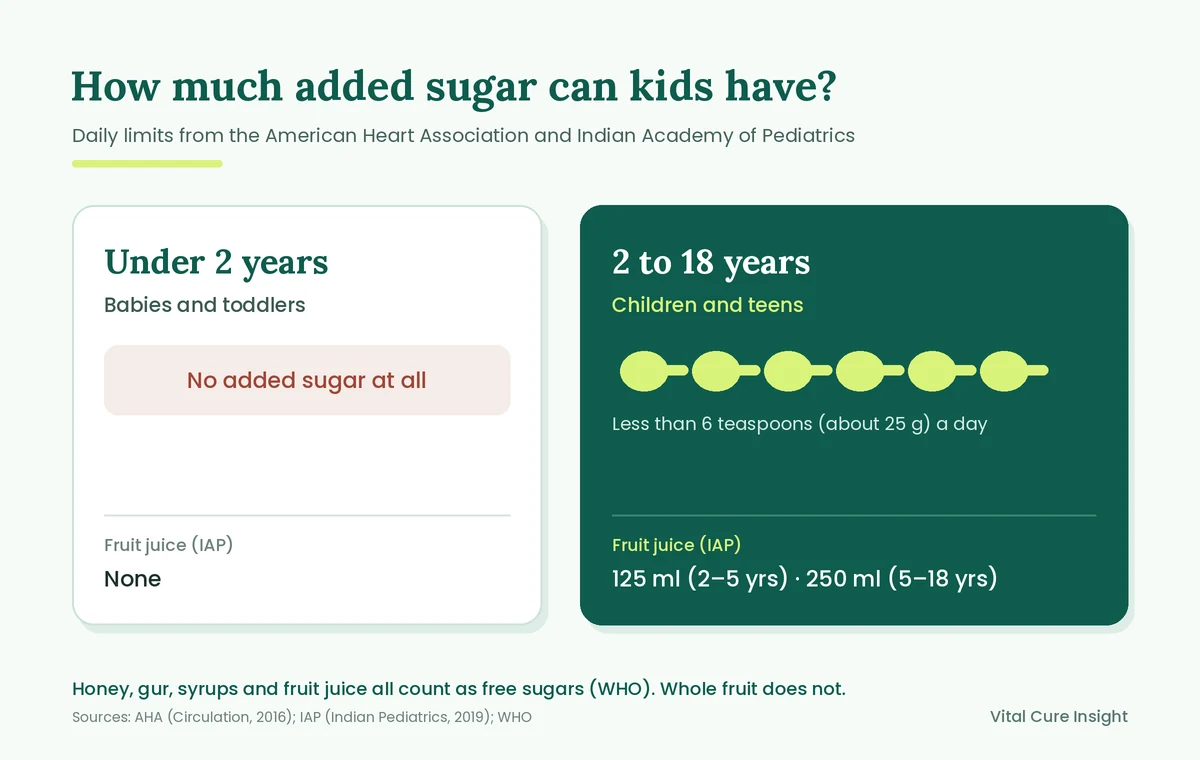
- Children under 2 should get no added sugar at all. From 2 to 18, the American Heart Association suggests less than 6 teaspoons (about 25 g) a day.
- Honey, gur, syrups and fruit juice all count as sugar. Whole fruit doesn’t.
- Roasted chana, makhana, sprouts, eggs, paneer, chilla, idli, fruit and plain dahi make easy low-sugar snacks.
- Water, plain milk and chaas beat juice, colas and “health drinks”.
How much sugar is too much for a child?
It helps to know the target before you plan snacks. The guidance from health bodies is surprisingly consistent:
| Age | Added sugar | Fruit juice |
|---|---|---|
| Under 2 years | None at all | Not recommended |
| 2 to 5 years | Less than 6 tsp (about 25 g) a day | Up to 125 ml a day |
| 5 to 18 years | Less than 6 tsp (about 25 g) a day | Up to 250 ml a day |
| Everyone | Free sugars under 10% of daily energy, ideally under 5% | Counts as free sugar |
The American Heart Association set the 25 g limit in a 2016 statement in Circulation and said children should have no more than one 8-ounce (about 240 ml) sugary drink a week. The Indian Academy of Pediatrics (IAP) published its own guidelines in 2019, endorsing WHO’s goal of keeping free sugars below 5% of energy. And ICMR-NIN’s Dietary Guidelines for Indians (2024) say plainly: no added sugar for children under 2.
One detail trips up many parents. The World Health Organization counts sugar added by the cook and the sugar naturally present in honey, syrups and fruit juice as “free sugars”. So a glass of fresh mosambi juice or a spoon of honey in milk counts towards the limit. Sugar inside whole fruit doesn’t.
15 healthy low-sugar snacks for kids (Indian ideas)
None of these needs special shopping. Most take ten minutes or less, travel well in a tiffin and cost a fraction of a packaged snack.
Crunchy snacks
- Roasted chana. ICMR-NIN specifically names roasted or boiled chickpeas, beans and peanuts as nutritious snack options. Buy them unsalted and add a pinch of chaat masala at home.
- Roasted makhana. Dry-roast in a kadhai or use half a teaspoon of ghee, then add a little salt and haldi. If you buy ghee loose, it’s worth knowing how to check purity of ghee at home.
- Roasted peanuts. Great for school-age children. For under-5s, crush them into chaat or poha instead, because whole nuts are a choking risk.
- Homemade popcorn. Pop plain kernels with a little oil and salt. Skip the caramel and butter-flavoured packets.
- Murmura bhel. Puffed rice with tomato, onion, cucumber, roasted peanuts and lemon. Leave out the sweet imli chutney or use just a few drops.
Filling snacks
- Moong sprouts chaat. Add tomato, cucumber and lemon. Pack the lemon separately so it doesn’t go soggy.
- Besan or moong dal chilla. Roll it around a little grated paneer for a protein-rich tiffin.
- Boiled egg. A simple favourite that needs no sugar at all.
- Paneer cubes. Toss with pepper and a little jeera powder.
- Mini idli, poha or vegetable upma. Make extra at breakfast and pack a small portion for later.
Naturally sweet snacks
- Whole seasonal fruit. Guava, banana, papaya, orange segments or a few slices of apple. The IAP favours regional, seasonal whole fruit over juice.
- Plain dahi with chopped fruit. It’s a far better choice than sweetened fruit yoghurt cups. Not sure how dahi and yoghurt differ? We covered curd vs yogurt here.
- Fruit with peanut butter. Choose unsweetened peanut butter and spread it thinly on apple or banana. For toddlers, don’t give nut butter on its own by the spoonful, as the NHS warns it can be a choking risk.
- Dates or raisins, with a meal. Dried fruit is concentrated and sticky, so the NHS suggests giving it at mealtimes rather than as a stand-alone snack.
Better drinks with snacks
- Water, chaas, plain milk or nimbu pani without sugar. The IAP calls water the best drink at home and in school. If your child drinks milk, our guide on how much milk to drink daily covers sensible amounts by age.
Easy swaps for common sugary snacks
| Instead of | Try | Why it helps |
|---|---|---|
| Cream or glucose biscuits | Roasted chana or makhana | Crunch without added sugar or refined flour |
| Packaged fruit juice | A whole orange or guava | Fibre stays in, and it fills them up more |
| Flavoured milk or malt “health drink” | Plain milk with a pinch of elaichi | Cuts out the added sugar |
| Sweetened fruit yoghurt | Plain dahi with chopped fruit | The fruit adds sweetness on its own |
| Chips | Homemade popcorn or murmura bhel | Less salt and oil, you control what goes in |
| Jam sandwich | Paneer or besan chilla roll | Protein keeps kids full longer |
| Cola or soft drink | Water, chaas or nimbu pani without sugar | No sugar at all |
A simple tiffin plan for the week
If mornings are rushed, decide the week’s snacks on Sunday. Here is one plan that keeps added sugar close to zero:
| Day | Main snack | Add on |
|---|---|---|
| Monday | Besan chilla roll with paneer | Cucumber sticks |
| Tuesday | Moong sprouts chaat | Guava slices |
| Wednesday | Mini idlis with coconut chutney | A banana |
| Thursday | Roasted makhana and chana mix | Orange segments |
| Friday | Vegetable poha | Plain dahi in a small box |
| Saturday | Homemade popcorn | Papaya cubes |
Rotate fruits with the season, and let your child pick between two options now and then. Letting them help choose makes the tiffin feel like theirs. For grown-up snack ideas along the same lines, see our list of healthy snack alternatives for cravings.
How to spot hidden sugar on Indian food labels
Packaged foods marketed to children are where most of the sugar hides. When you read a pack, look at the ingredients as well as the front.
- Sugar has many names. Watch for sugar, jaggery, honey, liquid glucose, glucose syrup, invert sugar, dextrose, fructose and malt extract. Several of them in one list add up.
- Order matters. Ingredients are listed from largest to smallest amount, so sugar near the top is a red flag.
- Check the serving size. The sugar figure is often per small serving, and most children eat more than that.
- Don’t trust the word “health”. In April 2024, the Ministry of Commerce and Industry told e-commerce sites to remove drinks such as Bournvita from their “health drinks” category, because “health drink” is not defined under India’s food law.
Schools are covered too. FSSAI’s 2020 school food regulations say foods high in saturated fat, trans fat, added sugar or salt cannot be sold to children in school canteens, or within 50 metres of the school gate.
Common myths about sugar and kids
“Gur and honey are healthy sugars.” They may feel more traditional, but both count as sugar added to food. WHO includes honey and syrups in free sugars, and the NHS says honey shouldn’t be given to babies under 1 at all.
“Fresh juice is as good as fruit.” Not quite. Juice counts as free sugar, and the IAP prefers whole seasonal fruit and limits juice by age.
“Children need sugar for energy.” No guideline sets a minimum for added sugar. Children get the energy they need from roti, rice, dal, milk, fruit and vegetables.
“No added sugar means healthy.” A pack can skip table sugar and still be an ultra-processed snack. The IAP groups ultra-processed foods with junk food in its advice.
What the evidence says
The case against added sugar for children rests mainly on two outcomes: weight gain and tooth decay. WHO bases its free sugar limits on both. The IAP’s review found that drinking sugar-sweetened beverages 4 to 6 times a week was linked with childhood obesity, that these drinks were linked with dental caries, and that eating fast food more than twice a week was linked with a higher BMI.
Most of this evidence comes from observational studies, so it shows links rather than proof that one biscuit causes harm. But the direction is consistent across WHO, the AHA, the IAP and ICMR-NIN, and the swaps above cost nothing in nutrition. That’s why we think the advice is worth following, without turning every birthday laddoo into a crisis.
Who should be careful
- Babies and toddlers under 2: no added sugar, no juice and no honey before age 1. Offer mashed fruit and home food instead.
- Children under 5: whole nuts and spoonfuls of nut butter can cause choking, as the NHS points out. Crush or grind nuts and spread nut butter thinly.
- Food allergies: peanut, milk and egg allergies are common. Replace those snacks with safe alternatives your doctor approves.
- Type 1 diabetes: snacks need to be planned with your child’s diabetes team, as timing and carbohydrate amounts matter.
- Children who are underweight or not growing well: the IAP guidance is meant for children with normal growth. Ask your paediatrician for a plan that fits your child.
See a doctor if your child is unusually thirsty, passes urine very often or is losing weight, and see a dentist for tooth pain or visible cavities.
Frequently asked questions
What snacks are low in sugar for kids?
Roasted chana, makhana, roasted peanuts, homemade popcorn, sprouts chaat, boiled eggs, paneer, besan chilla, idli, poha and whole fruit are all low in added sugar. Plain dahi with chopped fruit works well for a sweet craving. Pair snacks with water, chaas or plain milk instead of juice or flavoured drinks.
How much sugar can a child have in a day?
The American Heart Association suggests less than 6 teaspoons (about 25 g) of added sugar a day for children aged 2 to 18, and none at all under 2. ICMR-NIN also advises no added sugar under 2. Remember that honey, gur and fruit juice count towards this limit.
Is jaggery or honey better than sugar for kids?
Not in any way that matters for the limit. Gur and honey are still sugar added to food, and WHO counts honey and syrups as free sugars. Honey should never be given to babies under 1. Use any of them sparingly, and keep them out of the diet entirely before age 2.
Are biscuits a good snack for kids?
Most biscuits are made from refined flour with added sugar and fat, so they fall into the junk and ultra-processed group the IAP advises limiting. An occasional biscuit is fine, but roasted chana, makhana or fruit make a better everyday snack and keep children full for longer.
What should I pack in my child’s tiffin?
Pack one filling item and one fresh item: for example, a besan chilla roll with cucumber, sprouts chaat with guava, or mini idlis with a banana. Send water instead of juice. Rotating a weekly plan saves time on busy mornings and keeps the tiffin from getting boring.
Are fruit juices healthy for children?
Whole fruit is better. The IAP says children under 2 shouldn’t be given juice, children aged 2 to 5 can have up to 125 ml a day, and those aged 5 to 18 up to 250 ml, preferably fresh. Juice counts as free sugar, while whole fruit keeps its fibre.
The bottom line
Healthy low-sugar snacks for kids don’t need to come from a packet or cost extra. Roasted chana, makhana, sprouts, eggs, paneer, fruit and plain dahi cover crunchy, filling and sweet cravings, and water or chaas can replace juice. Keep added sugar under about 6 teaspoons a day after age 2, and none before. For more practical guides on everyday Indian foods, browse our Diet & Nutrition section.
Sources
- Vos MB, et al. Added Sugars and Cardiovascular Disease Risk in Children: A Scientific Statement From the American Heart Association. Circulation (reported by ScienceDaily). 2016.
- Gupta P, Shah D, Kumar P, et al. Indian Academy of Pediatrics Guidelines on the Fast and Junk Foods, Sugar Sweetened Beverages, Fruit Juices, and Energy Drinks. Indian Pediatrics. 2019.
- ICMR-National Institute of Nutrition. Dietary Guidelines for Indians. 2024.
- World Health Organization. Healthy diet (fact sheet). 2026.
- NHS. Healthier snacks. Accessed October 2026.
- NHS. Foods to avoid giving babies and young children. Accessed October 2026.
- Food Safety and Standards Authority of India. Press release: Safe food and balanced diets for children in school regulations. 2020.
- Business Today. Remove Bournvita from ‘Healthy Drinks’ category: Govt tells e-commerce firms. 2024.
This article is for general information and is not a substitute for advice from your doctor.
Free weekly email
One evidence-checked health read, straight to your inbox.
New articles and myth-busts, with the sources linked. No spam — unsubscribe any time.
By subscribing you agree to receive emails from Vital Cure Insight. See the privacy policy.